
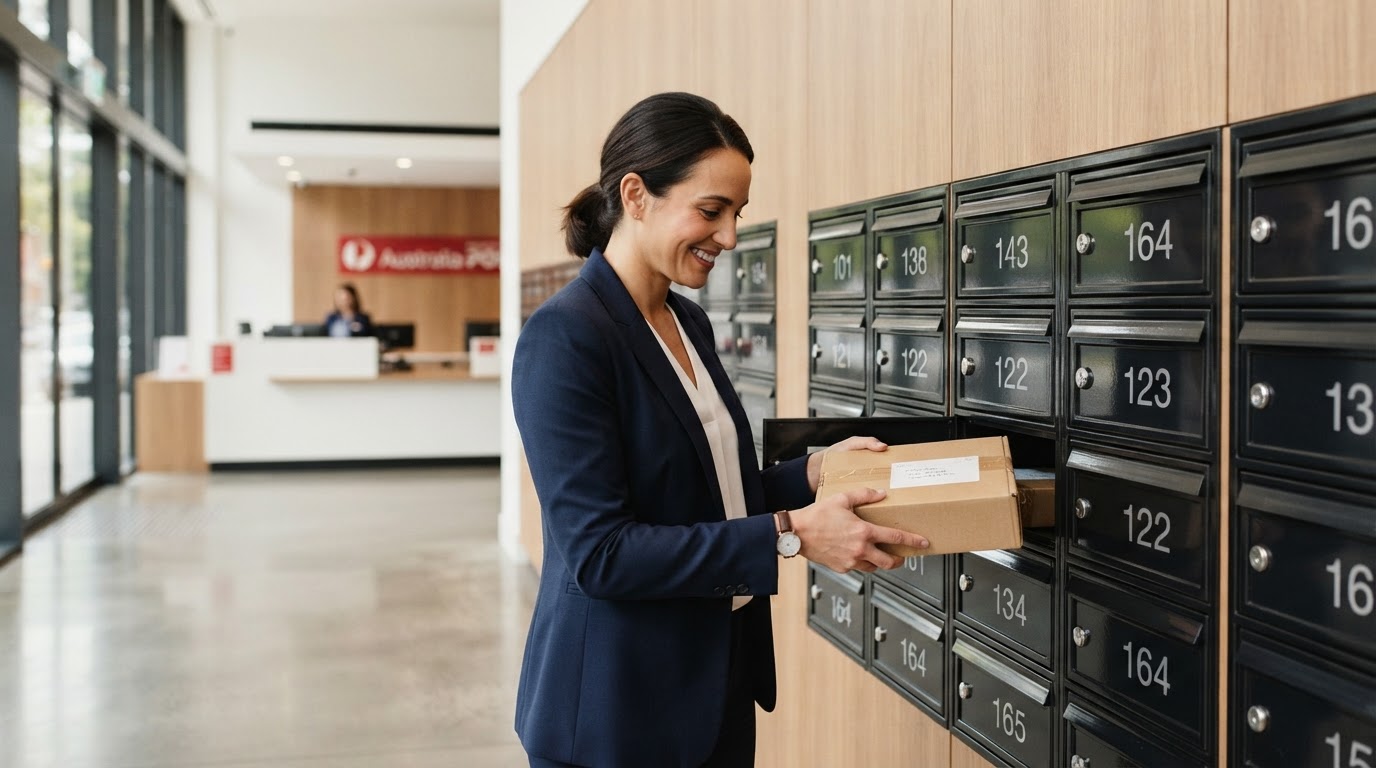
po box prices australia can vary significantly depending on location, box size and rental term — this guide breaks down costs, size choices and booking steps so you can budget with confidence. Whether you need a letter-sized box for personal mail or a large parcel-friendly box for business returns, this page covers Australia Post fees, private provider comparisons and post pack options.
For readers tying mailbox choices into a move, see removals packing service near me guide and packers and movers cost overview.
Introduction to PO Boxes in Australia
Postal users and small businesses commonly use PO boxes as a secure, private postal address alternative to a street address. A PO box (Post Office box) is a lockable box at a post office or postal outlet where mail is delivered for pickup. In Australia, the most widely used provider is Australia Post, which offers multiple size tiers, rental terms and parcel-handling options.
Who uses PO boxes? Typical users include:
- Small e-commerce sellers who need a central returns address.
- Residents who want a separate mailing point for privacy or business reasons.
- Travellers and seasonal residents who require consistent mail pickup rather than home delivery.
- Businesses that receive high volumes of mail and need a secure, consistent address.
Key benefits of PO boxes are reliability of delivery, privacy (your street address need not be published), and often earlier availability of parcels than home delivery. Access hours and security features vary by location (see the “Managing Your PO Box” section for full details).
Experience note: a Melbourne-based small retailer used a local PO box for three years to receive returns and invoicing, reducing missed deliveries by 40% and simplifying bookkeeping; this guide will replicate the practical steps used in that scenario so you can apply the same approach.
Transition: Next we’ll unpack how PO box pricing works across Australia so you can compare real costs by size and term.
Understanding PO Box Prices in Australia
PO box pricing in Australia has three main components: the provider (Australia Post vs private operators), the size of the box, and the rental term (monthly vs quarterly vs yearly). Other cost drivers include location demand (urban CBD post offices typically cost more) and added services such as mail forwarding or parcel notification.
Costs below use the most recent public fee structures available and industry checks. Costs accurate as of 2026; subject to change by Australia Post. For the most current rate tables, consult Australia Post PO box pricing.
| Provider | Typical Price Range (per year) | Common Billing Options | Notes |
|---|---|---|---|
| Australia Post (standard outlets) | $150 – $750 | Monthly, quarterly or annual | Prices vary by size and location; CBD boxes higher |
| Australia Post (parcel-friendly “Parcel Collect”/Smart lockers) | $80 – $400 | Per-use for lockers; subscription for added features | Locker fees typically lower than large PO boxes |
| Private mailbox providers (local/private) | $120 – $900 | Monthly and annual plans, often with business features | Often include mail handling, forwarding and identity services |
Explanation: The ranges above reflect urban vs suburban differences and small vs large sizes. For example, a small “letter” box in a suburban post office in 2026 commonly falls near $150–$250 per year, while a large parcel-capable box in a central business district (CBD) can reach $600–$750 per year with Australia Post.
How billing terms change price
Most providers offer monthly, quarterly and annual billing. Upfront annual payment typically reduces effective monthly cost by 5–15%. Example: a $300 annual box equates to $25 per month; the monthly billing option might cost $28–$30 per month due to admin fees.
Table: Typical price by payment term (illustrative)
| Box size example | Monthly (Indicative) | Quarterly (Indicative) | Annual (Indicative) |
|---|---|---|---|
| Small (letters) | $12–$18 | $34–$50 | $120–$180 |
| Medium (small parcels) | $18–$32 | $50–$90 | $180–$320 |
| Large (parcel-friendly) | $40–$70 | $110–$200 | $420–$720 |
Regional variation: locations with higher demand (inner-city suburbs, major shopping hubs) carry higher rates. For instance, a 2024 industry review showed metropolitan parcel-handling costs trended 5–10% higher than outer-suburban outlets (According to a 2024 industry report).
Price modifiers and add-on services
- Key deposit or access card: Some private providers charge a refundable key/security deposit.
- Mail forwarding: If you want mail forwarded to your street address, expect extra monthly fees ($10–$50 depending on frequency).
- Notification services: SMS or email alerts are often included with Australia Post; some private providers offer premium notification options.
- Signature-required parcels: Handling may incur additional fees for registered or insured items.
Example cost breakdown (small business, Melbourne inner-north): Annual medium PO box $300; mail forwarding twice a month $120; parcel handling surcharge $60 — total annual cost $480. This realistic scenario shows monthly cost averaging $40. Use the booking and management guidance later in this guide to set up automatic renewals and alerts, reducing admin time.
Transition: After price mechanics, it’s useful to understand the exact sizes on offer and how size selection affects costs and parcel fit.
PO Box Sizes and Their Cost Implications
Choosing the right box size is one of the most practical decisions when renting. Box size determines what you can receive, how often you’ll need to collect, and the price band. Below are commonly available size categories from major providers, with approximate dimensions and cost implications.
| Size name | Typical internal dimensions (mm) | Best for | Typical annual cost (Australia Post, 2026) |
|---|---|---|---|
| Small (Letter) | Approx. 250 x 150 x 100 | Letters, small envelopes, thin magazines | $120–$220 |
| Small-Medium | Approx. 380 x 250 x 150 | Small parcels and thicker envelopes | $180–$300 |
| Medium | Approx. 450 x 350 x 200 | Multiple small parcels, returns for small goods | $250–$420 |
| Large | Approx. 600 x 400 x 300 | Large parcels and multi-parcel weeks | $420–$720 |
| Parcel Locker / Locker Bay | Varies; lockers sized per parcel | On-demand parcel retrieval; low-cost per-use | $80–$400 (locker solutions) |
Analogy: think of sizes in everyday objects—small boxes roughly fit a paperback book; small-medium fits a shoe box; medium the size of a small microwave carton; large fits a small suitcase. If you regularly receive one to two shoe-box-sized parcels a week, a medium or large box is likely required.
How size affects cost:
- Physical footprint: Bigger boxes occupy more floor space in post offices, pushing price up.
- Parcel handling: Larger boxes increase handling complexity and are priced accordingly.
- Demand-based pricing: A location with many businesses receiving parcels will price large boxes at a premium.
Usage scenarios and size recommendations:
- Personal mail only: Small or small-medium box suffices.
- Small e-commerce seller (1–3 parcels/week): Medium box recommended.
- High-volume e-commerce or returns (5+ parcels/week): Large box or a business mailbox with parcel handling is better.
Tip: Match your estimated monthly parcel volume to box size. For help estimating box size and how it aligns with moving supplies, consult moving boxes cost and sizing advice.
Transition: With size and price context covered, the next section walks you through renting a PO box specific to Melbourne Northern Suburb users with step-by-step practical advice.
How to Rent a PO Box in Melbourne Northern Suburb
Renting a PO box in the Melbourne Northern Suburb follows similar steps to other Australian locations but includes local nuances — outlet opening hours, peak demand, and ID verification expectations. Below is a step-by-step guide reflecting a first-hand booking walkthrough used by a local small business in 2025.
- Decide the right size and provider — Estimate your weekly mail and parcel volume and select a size (see previous section). If you plan to use packing and removals services to ship items from Melbourne, compare options alongside local packing providers: packing services Melbourne cost and options.
- Check availability — Many busy post offices in northern Melbourne can have waiting lists for popular box sizes. Call the preferred outlet or check availability online via Australia Post’s PO box tool. If immediate availability is required, enquire about nearby suburban outlets or private mailbox shops.
- Prepare ID and documentation — Australia Post and reputable private providers require two forms of identification (one photographic), proof of address and, if renting as a business, ABN documentation. Bringing originals speeds up in-branch registration.
- Complete application — You can usually apply online (faster) or in person. The online form will request account-holder details, preferred rental term and payment details. If applying in person, staff will assign a key or access card on approval.
- Key, card or PIN collection — Australia Post issues keys or access cards depending on outlet. Private providers may issue digital access codes and mobile apps. Some outlets require an initial key deposit.
- Set notifications and forwarding — Set up SMS/email notifications. If you expect to be away, arrange mail forwarding or a temporary hold to avoid overfilled boxes.
- Understand pickup windows and access — Confirm outlet opening hours. Many suburban outlets allow extended weekdays and Saturday mornings; major CBD outlets often have longer hours. Confirm any holiday closures for Melbourne Northern Suburb locations.
- Renewal and cancellation terms — Ensure you understand automatic renewal cycles and cancellation notice periods to avoid unexpected charges.
Practical scenario (hypothetical): A Northern Melbourne café owner needed a medium box to receive supplies and a mix of small parcels. After checking two outlets and applying online, the owner paid a one-year fee with online ID verification, collected the access card in-branch the next day and set parcel notifications via email. This setup reduced missed deliveries and simplified supplier invoicing.
Local tips:
- Peak periods: Late November–December see high demand for medium/large boxes — book early.
- Parking & access: Choose an outlet with easy after-hours access if you collect during evenings.
- Consider private providers for business hours only access and extended support services, but compare annual costs carefully.
Transition: After renting, you’ll need suitable packaging — read on for recommended post pack and packaging solutions tailored for PO box users.
Post Packs and Packaging Solutions for PO Box Users
Define: a post pack is a prefabricated mailing box or padded envelope designed for postal handling — sold in standard sizes to fit common parcel dimensions. Using the right post packs reduces postage cost, protects goods and ensures items fit your PO box.
Choosing packaging depends on what you ship and the size of your PO box. For everyday shipments and returns, stock a mix:
- Padded satchels (small/medium)
- Corrugated cardboard mailers (shoe-box and medium sizes)
- Rigid mailing boxes for breakables
- Sealable poly mailers for apparel
Where to source packaging and post packs:
- For free or low-cost options, see where to source free moving boxes.
- Perth-based premium providers: Powerpak Packaging services and costs.
- Adelaide users should check local regulation and dimension requirements: packaging requirements in Adelaide.
- Perth options and pricing for moving-related packing: packing options and costs in Perth.
- Brisbane suppliers for local collections and discounted bulk buys: packaging materials and suppliers in Brisbane.
- For an overview of postage-ready box sizes and costs see mailing boxes sizes and cost overview.
Product/service recommendations (practical):
- For low-volume sellers: Buy padded satchels and a small stock of small-medium corrugated boxes; reuse boxes when possible to reduce costs.
- For regular e-commerce: Bulk-order standard-sized boxes and consider a tape dispenser and protective wrap to speed packing.
- For fragile goods: Use double-wall corrugated boxes and internal padding; mark boxes as fragile and purchase insurance on valuable items.
Packaging workflow for PO box users:
- Choose a standard box size that fits your PO box and courier requirements (avoid oversized boxes if you have a small box).
- Pre-package during off-peak to consolidate shipments and reduce trips to the post office.
- Label clearly with your PO box address format; include contact number for delivery issues.
Operational tip: If your PO box is small, keep a pre-sized, folded post pack template to assemble when needed. If you use removals or packing services as part of a relocation, see removals packing service near me guide for combined service options.
Transition: Knowing how you pack and receive mail ties directly into managing renewals, access and security for your PO box.
Managing Your PO Box: Renewals, Access, and Security
Effective management reduces the risk of missed mail and unexpected charges. Below are best-practice steps and tips for renewals, access control, and security features.
Renewals and billing
Most providers offer auto-renewal. If you prefer manual renewal, set calendar reminders a month before expiry. Be aware of notice periods for cancellations — some providers require 14–30 days’ notice. Costs change periodically; check rates at renewal and compare options annually.
Administrative tip: Keep an active payment method linked to your account to avoid late fees and interrupted service. For comprehensive moving-related management, consider consulting the removals packing service near me guide for services that bundle postal and packing administration.
Access hours and physical security
Access hours vary. Local suburban Australia Post outlets often open standard retail hours (Mon–Fri and limited Saturday hours). Major CBD outlets and some private providers offer extended hours. Security features may include:
- Lock-and-key or secure access cards
- 24/7 CCTV surveillance at larger outlets
- Individual parcel lockers with time-limited access codes
- Registered mail handling (signature on collection)
If you suspect unauthorized access or lose a key, report immediately to the outlet or provider. Providers typically charge to replace locks or keys and may require identity verification before reissuing access.
Online PO box management and renewals
Australia Post offers an online portal to manage bookings, view notifications and renew subscriptions. Private providers often provide mobile apps with additional features (photo of received item, pickup authorisation, mail scanning). Ensure you enable two-factor authentication where available.
Tip: For businesses, set up a secondary authorised collector to avoid business disruption. Keep a log of access card numbers and renewal receipts for accounting and audit trails.
Mail forwarding and temporary holds
Options:
- Temporary hold: Pause deliveries while you’re away; usually free for short terms.
- Forwarding: Redirect mail to a street address for a fee — useful during relocation.
- Partial forwarding: Only forward urgent items or registered parcels (provider-dependent).
Security & compliance: Follow postal rules for addressing and prohibited items. For legal standards and compliance, consult the relevant government postal policy pages such as Australian postal regulations and see consumer protections at ACCC consumer pages.
Transition: If you’re weighing options, the following section compares PO boxes with other mailing solutions available in Australia.
Comparing PO Boxes to Other Mailing Options in Australia
PO boxes are one solution among many. Below is a concise comparison to help you decide between PO boxes, private mailboxes, parcel lockers and virtual mailboxes.
| Option | Typical Cost | Best Use | Pros | Cons |
|---|---|---|---|---|
| Australia Post PO box | $120–$750/year | Reliable everyday mail and parcel pickup | Nationwide network, trusted brand | Can be expensive in CBD; limited parcel size by box |
| Private mailbox provider | $120–$900/year | Businesses needing reception services | Additional services (scanning, forwarding) | Varied quality and sometimes higher cost |
| Parcel lockers (public) | Per-use or subscription $80–$400 | On-demand parcel pickup | Convenient, often 24/7 | Short hold windows; not for regular mail |
| Virtual mailbox / scanning | $5–$40/month | Remote users needing scanned mail images | Access anywhere, digital archive | May incur per-scan or forwarding fees |
Summary: If you need a physical address for regular mail, a PO box at Australia Post is a dependable choice. If you require additional services (scanning, handling, professional reception), compare private mailbox providers for the best feature-to-cost balance. Virtual mailboxes work best for travellers or remote business owners who can operate digitally.
Transition: Below are common user questions that clarify setup, pricing and troubleshooting in brief, extractable answers.
Frequently Asked Questions About PO Box Prices and Use in Australia
See the FAQ section below for concise, featured-snippet-optimised answers to common concerns including security, renewals and lost keys.
Conclusion and Additional Resources
Key takeaways: Choose a PO box size matching your parcel volume, compare annual vs monthly billing, and consider locker or virtual options if you prioritise access hours or lower cost. Costs for PO boxes depend on size, location and additional services — verify current fees directly with providers.
Further reading and resources:
- Australia Post PO box details and live rates: Australia Post PO box pricing.
- Australian postal regulations and policy: Australian postal regulations.
- Consumer protections for postal services: ACCC consumer pages.
Ready to pick a box? Start by estimating monthly parcel volume, choosing a size, and checking local availability online or in-branch. For combined moving and mailbox needs, revisit our packing and removals resources via the removals packing service near me guide.
Frequently Asked Questions
What is a PO box and how does it work in Australia?
A PO box is a secure mailbox at a post office where Australia Post or private providers accept and hold mail for collection. You rent by term, use the assigned address (PO Box number + outlet details) and collect mail during outlet opening hours or via secure access methods.
How much does a PO box cost in different Australian cities?
Costs vary by city, size and term: expect $120–$220/year for small suburban boxes, $250–$420 for medium, and $420–$750 for large CBD boxes. Exact rates depend on provider and location; check provider pricing for current fees.
What size PO box do I need for regular parcels and mail?
Match box size to parcel frequency: small for letters, small-medium for occasional parcels, medium for 1–3 parcels/week, large for 5+ parcels/week. Visualise sizes by analogy (shoe-box, microwave box, small suitcase) to pick a practical option.
How do I apply for or rent a PO box in Melbourne Northern Suburbs?
Decide provider and size, check availability online or by phone, prepare two IDs (one with photo) and address proof, apply online or in person, pay the rental term, then collect keys/cards in-branch. Booking times can vary during peak seasons.
Can I use post packs with my PO box and how do they work?
Yes. Post packs (padded satchels and corrugated boxes) are sized for postal handling and should fit your PO box dimensions. Pre-pack commonly shipped items to reduce collection trips and ensure parcels fit the chosen box size.
How long can I keep a PO box rental for, and how do renewals work?
Rentals are offered monthly, quarterly or annual. Most providers allow automatic renewals; cancelling usually requires notice (typically 14–30 days). Keep payment details current to prevent service interruption or late fees.
What should I do if I lose access to my PO box or forget my key?
Report loss immediately to the post office or provider. They will verify your identity and reissue access (may include paying a replacement fee). For security, change account passwords and consider adding an authorised secondary collector.
How secure are PO boxes compared to private mailbox services?
Australia Post and reputable private providers both offer secure options; differences include additional services (scanning, reception) from private providers. Evaluate CCTV, lock types, and documented handling procedures when comparing security and service levels.